Excavation for Your NSW Homes: A Homeowner's Guide to Costs, Approvals, and Hiring
You've got a project taking shape in your head: a pool, a granny flat out the back, and a landscaped yard that finally makes the most of the block. Then someone mentions excavation, and you're not sure where to start. What will it cost? Do you need council approval? How do you find a contractor you can actually trust?
Excavation projects in NSW are more straightforward than most people expect, but only once you understand a few fundamentals. Costs vary more than most quotes suggest. Approval requirements depend on the scope and what's below your soil. And the contractor you choose will have a bigger impact on how the job runs than almost anything else.
This home excavation guide covers all of it: what excavation at home actually involves, realistic NSW cost ranges, when you need council approval, what questions to ask before signing a quote, and what to expect on the day.
What Does Home Excavation Actually Involve?
Excavation for home projects is the process of removing soil and rock from your property to prepare a site for construction. That might mean digging out the footprint for a pool, stripping and regrading a sloping backyard before turf goes down, cutting a slab for a granny flat, or preparing footings for a home extension. The work can range from a one-machine day job to a multi-week scope involving structural consideration, drainage, and council sign-off.
MRN Excavations is a Macarthur and South West Sydney excavation specialist with 13 years of hands-on experience. Most first-time homeowners underestimate two things: how much soil type affects cost, and how important it is to have a licensed contractor assess the site before the quote is written. NSW also has specific licensing requirements and council approval triggers that affect what you can do and how it gets done.
When Do You Actually Need Excavation?
Most residential excavation jobs in NSW fall into one of five categories. Knowing which one applies to your project will help you understand what's involved before you speak to a contractor.
Pool Installation
Pool excavation is the most common residential dig in NSW. The machine cuts to the depth and shape the pool design requires. The spoil is removed by tip truck, and the hole is handed over to the pool builder. Access and soil type are the two main variables. Tight gates mean smaller equipment and longer setup, and Sydney sandstone can require hydraulic hammering on top of standard dig rates.
More details in MRN's guide to pool excavation costs.
Backyard Regrade and Landscape Prep
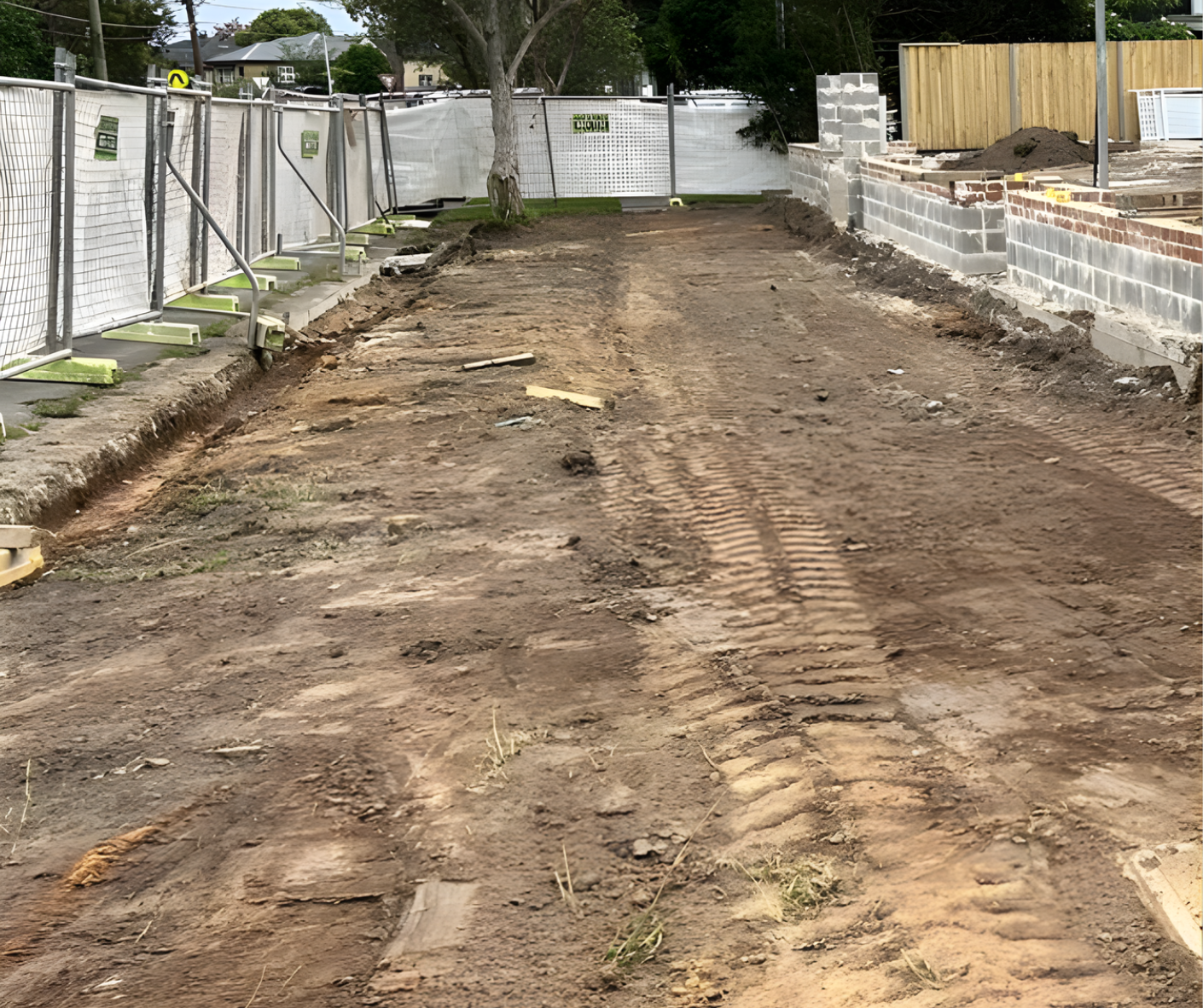
Sloping or uneven blocks across the Macarthur region and outer south-west Sydney often need levelling before turf, retaining walls, or an entertaining area can go in. Reactive clay is the dominant soil type in these areas. It swells when wet and shrinks when dry, and a good operator grades the finished surface with that movement in mind.
The excavation for landscaping guide covers why this matters.
Basement Conversion or Under-House Excavation
Converting a sub-floor into a liveable space is growing in popularity, particularly on blocks where building up or out would trigger council constraints. It is specialist work. The structure above must be supported, soil removal happens in confined conditions, and council approval is almost always required.
Read MRN's posts on what a basement excavation involves and how to excavate a basement safely before proceeding.
[Future cluster post: "Excavation for a Basement Conversion: A NSW Homeowner's Full Guide" — link when live]
Granny Flat or Home Extension Slab
NSW's State Environmental Planning Policy for granny flats has made fast-track approvals more accessible for qualifying properties, and that has accelerated construction across the South West Sydney and Macarthur corridor.
Slab excavation for a granny flat involves trimming the site to the correct depth, managing drainage interaction with the existing structure, and working around underground services that may not be marked. Getting the slab prep right is critical. A level, correctly drained base saves significant remediation costs later.
[Future cluster post: "Excavation for a Granny Flat or Home Extension" — link when live]
Driveway Preparation
Sub-base depth varies by surface finish: concrete, asphalt, and pavers each have different requirements. Site slope affects compaction and sediment control during the dig. It is often treated as a minor job, but cutting corners here leads to an uneven surface and costly repairs down the track.
[Future cluster post: "Driveway Excavation: A NSW Homeowner's Cost and Process Guide" — link when live]
| Job Type | Typical Machine | Rough Dig Time | NSW Cost Range (Guide Only) |
|---|---|---|---|
| Pool excavation | 6t or 8.5t excavator | 1 to 2 days | Varies significantly by pool size and soil |
| Backyard regrade | 1.7t or 6t, depending on access | Half day to 1 day | From $400 to $1,500+ |
| Basement conversion | Specialist equipment | Days to weeks | Significantly higher: scope and access dependent |
| Granny flat slab | 6t excavator | 1 day | Varies by site conditions |
| Driveway prep | 1.7t or 6t | Half day | From $400 upward, depending on the area |
Note: These are indicative ranges based on MRN's field experience. An on-site assessment is always needed for an accurate quote.
How Much Does Home Excavation Cost in NSW?
Cost is the question every homeowner asks first, and the honest answer is that it depends on more variables than most quotes make clear. That's not a dodge. It's the reality of a job where soil conditions, machine access, spoil volume, and site complexity all affect the final number. What you can do is understand the main drivers and go into any quote conversation knowing what to ask about.
The Main Cost Drivers
Volume of material is the starting point. Length, width, and depth of the dig area multiplied together give you the cubic metres of soil to be removed, and that number underpins most pricing.
Soil type is often the biggest cost variable. Clean sandy loam is the easiest and cheapest to dig. Reactive clay, which is common across Macarthur and outer South West Sydney, takes longer to move and behaves differently when disturbed. Sydney sandstone is the most significant cost factor of all. When rock is encountered at shallow depth, hydraulic hammering may be required, and the per-cubic-metre rate rises sharply.
Machine size and site access affect how quickly the job can be done and what equipment is needed. A tight site gate that only admits a 1.7-tonne mini excavator means the work takes longer than an open site where a 6-tonne or 8.5-tonne machine can operate freely.
Spoil removal is a cost that surprises many homeowners. Excavated material needs to go somewhere. Tip fees at NSW transfer stations apply, and the number of truck movements depends on the volume. Any quote that does not clearly state whether spoil removal is included should be queried before you sign.
Rock contingency should be factored in for inner Sydney, the Sutherland Shire, and anywhere with a history of shallow sandstone. Even a small patch of rock encountered mid-dig can change the cost significantly.
Realistic NSW Cost Ranges
Simple backyard or landscape dig: from approximately $400 to $1,500, depending on scope and access. For a more detailed breakdown of what drives the per-cubic-metre rate, MRN's dedicated cost guide on how much it costs to excavate a backyard in NSW is a useful reference.
Per cubic metre: a typical clean dig runs approximately $50 to $80 per cubic metre. When ripping or hammering is required for sandstone, that figure rises to $150 or more per cubic metre, sometimes significantly higher depending on rock hardness and depth.
A general cost guide is also available on how much excavation costs for homeowners wanting a broader reference before approaching contractors.
Macarthur clay and Sydney sandstone: two conditions that change your cost
Macarthur and outer South West Sydney blocks commonly sit on reactive clay soils. These take longer to excavate cleanly and can require additional drainage consideration at the finished grade. Inner Sydney and the Sutherland Shire frequently hit sandstone at shallow depth: sometimes less than a metre down. Sandstone requires hydraulic hammering rather than standard bucket work, which adds both time and cost that cannot be known until the machine is in the ground. Mat has worked across both conditions extensively and will flag the likelihood of each at your site assessment before the quote is written.
Do You Need Council Approval for Home Excavation in NSW?
This is one of the most common questions homeowners ask, and the answer is not a simple yes or no. It depends on the scope of the work, the proximity to boundaries and services, and the rules in your specific council area.
When Approval Is Generally Not Required
Minor landscape excavation, levelling garden beds, and general earthworks on your own property within modest depth and volume thresholds typically do not require a Development Application (DA) or a Complying Development Certificate (CDC). The specifics vary by council. Before starting any dig beyond basic garden work, a quick call to your local council to confirm what applies to your scope is always worthwhile.
For a detailed breakdown of permit triggers in NSW, MRN's guide on whether you need a permit to excavate your land is worth reading before you commit to a project scope.
When Approval Is Likely Required
Works that affect drainage or neighbouring properties, excavation near boundaries or below existing footings, and any work that triggers a DA or CDC under the NSW Environmental Planning and Assessment Act will all require council sign-off before work starts.
Basement conversions almost always require structural certification and development approval, regardless of the scope. If your project involves significant earthworks near a boundary, always check with the council before engaging a contractor.
Dial Before You Dig
Before any residential dig in NSW, you must check for underground services using Dial Before You Dig. This free service identifies the location of gas lines, water mains, power cables, and telecommunications infrastructure below your property.
It is a legal requirement and takes minutes to complete online. No reputable contractor should start work without confirming this has been done.
Contractor Licensing in NSW
In NSW, you need a contractor licence to do any residential building or trade work, including excavating, which is valued at more than $5,000 in labour and materials (including GST). This means almost any residential excavation project you are planning will require a licensed contractor.
You can verify a contractor's licence through the NSW Building Commission's online check tool before signing anything. MRN holds licence number 384683C, and Mat is happy to show documentation before a quote is submitted.
What Equipment Will Be Used on Your Site?
Machine selection is not a one-size-fits-all decision, and a good contractor matches the equipment to the job rather than just sending whatever is available. Understanding the basics will help you have a more informed conversation with any contractor you speak to.
Matching Machine Size to the Job
MRN's fleet covers the full residential range. The 1.7-tonne mini excavator is designed for tight residential access: narrow side gates, confined backyards, and working close to existing structures.
The 6-tonne and 8.5-tonne excavators handle bulk digs, pool excavations, and open sites where larger volumes and faster cycle times make sense. The 2.8-tonne bobcat comes into its own for material spreading, backfill work, and finished surface prep after the main dig is done.
For a broader overview of how machine types and sizes compare, MRN's home excavation guide to popular excavator types in Australia covers the field clearly.
Tight Access and Side Gate Access
"My side gate is only 900mm wide; will a machine fit?" is one of the most common questions Mat hears from homeowners before a job. The answer is almost always yes. The 1.7-tonne mini excavator is designed precisely for this situation, and most standard residential side gates can be cleared.
The trade-off is cycle time: a smaller machine working in a confined space takes longer than a larger machine on an open site, and that affects cost. For jobs where tight access is a real constraint, MRN's post on tight access excavation covers what to expect in more detail.
Hiring an Excavator for Your NSW Home Project
You have done your research. Now you need to choose the right person for the job. This section covers what to look for, not a list of vague reassurances.
Licence and Insurance
Confirm the contractor holds a current licence before you sign anything. You can verify this through the NSW Building Commission’s official licence register. Under the Home Building Act 1989 (NSW), unlicensed contracting can attract penalties of up to 200 penalty units for individuals or 1,000 penalty units for corporations.
Ask for the contractor’s licence number and confirm it matches the register, along with evidence of current public liability insurance and contract works insurance relevant to the scope of the job. For residential building work over $20,000, confirm that the
Home Building Compensation Fund (HBCF) applies and request the certificate before any payment or commencement of work.
Written Quote Versus Verbal
Always get a written quote. A good written quote should itemise the excavation scope, machine and operator, spoil removal (or clearly state that it is excluded), float charges if the machine is being transported to the site, and the payment schedule.
The most common cause of quote blowouts is not including the spoil disposal costs. Ask specifically: "Is tip removal included in this price, and if so, how many truck movements is that based on?"
Face-to-Face Site Assessment
Any reputable contractor should visit the site before providing a quote. A site visit allows them to check access, assess soil conditions visually, identify proximity to services, and flag any constraints that would affect the scope or price.
At MRN, Mat comes out personally for the initial meeting and site assessment. There's no quoting from a satellite image. If a contractor offers to quote without seeing the site, treat that as a reason for caution.
What to ask your excavator before signing:
- Are you currently licensed for excavating work in NSW? (ask for the licence number)
- Do you carry public liability insurance and contract works insurance?
- Is spoil removal included in the quote, and how many truck movements does that cover?
- Will you provide a written, itemised quote?
- What is your payment schedule: deposit, progress, or final?
- Will you visit the site before quoting?
- What is your lead time from quote acceptance to start date?
What to Expect on Excavation Day
If this is your first residential excavation, here is an honest picture of what the day looks like.
Before the crew arrives: Clear the access path from the street to the dig area. Move garden furniture, potted plants, and anything else that is in the way. If you know where your water meter is, mark it. Same for any visible service markers on your property. If you are unsure where underground services run, confirm that Dial Before You Dig has been completed before the machine arrives.
What happens on the day: The excavator arrives on a float truck and is unloaded at the front of the property. Mat marks out the dig area on the ground before the machine goes in. Digging begins, and excavated material is loaded into tip trucks as the work progresses. Depending on the volume and access, multiple truck movements may happen throughout the day.
Dust, noise, and timing: Excavation for a home is noisy. Plan for it. Dust is generated depending on soil conditions and weather. MRN works to minimise both, but this is practical site work, and some level of noise and mess is normal. Most residential jobs start early in the morning and work through to mid-afternoon, though scope and access will determine the actual hours.
What handover looks like:
When MRN completes the dig, the site is left clear of debris and excess spoil. The finished surface is at the agreed level. Mat or a crew member will walk through the completed work with you before leaving. Final payment is due on completion once you are satisfied with the result.
Managing Neighbours and Trees During Home Excavation
There are two things homeowners often overlook until it is too late.
Telling Your Neighbours
A heads-up to your neighbours before a noisy excavation job starts is both courteous and, in some circumstances, a legal requirement.
For works near a shared boundary or where vibration from the machine could reasonably affect the adjoining property, a dilapidation report documenting the existing condition of the neighbouring structure before work starts is worth considering. It protects you, as well as your neighbour, if any dispute arises after the job.
Trees and Excavation
Most NSW councils maintain Tree Preservation Orders (TPOs) covering significant trees on private and public land. Excavating within the root zone of a protected tree without approval can be an offence, and the consequences can be serious.
Before any dig near established trees, check with your local council whether a TPO applies and what the exclusion zone is. Professional operators work around protected trees where possible. Where the job cannot proceed safely without impacting a protected root zone, the work may need to pause while council approval is obtained.
Conclusion
Residential excavation in NSW is a well-defined process once you understand the basics. Costs, approvals, and contractor selection all become clearer once you know what to look for, and that clarity is what makes the difference between a job that runs smoothly and one that doesn't.
MRN Excavations works with homeowners across Sydney, Macarthur, Wollondilly, and the South Coast on residential excavation, screw piers, and lawn landscaping.
If you are ready to take the next step,
message us to book your site consultation.
Key Takeaways
- Most residential excavation in NSW falls into one of five job types: pool, backyard regrade, basement conversion, granny flat slab, or driveway preparation. Knowing which applies to your project helps you go into the quoting process prepared.
- Cost depends on soil volume, soil type (reactive clay and sandstone both add cost in NSW), site access, and whether spoil removal is included. Always get an itemised written quote before committing.
- Council approval requirements depend on the scope. Minor landscape earthworks often do not need a DA, but works near boundaries, drainage, or footings usually do. Always use Dial Before You Dig before any dig, regardless of scope.
- In NSW, a contractor licence is required for excavating work valued over $5,000 in labour and materials. Verify the licence number via the NSW Building Commission before signing anything.
- Machine size is matched to site access. MRN's 1.7-tonne mini excavator fits through most standard side gates. Tight access adds time but does not make a job impossible.
- A reputable contractor visits your site before providing a quote. If they are quoting without a site inspection, ask why.
Frequently Asked Questions About Home Excavation in NSW
How much does it cost to excavate for a pool in NSW?
Pool excavation costs in NSW depend on factors like pool size, soil type, site access, and whether sandstone or rock is present. A site inspection is usually required to provide an accurate quote.
Do I need a permit to excavate my backyard in NSW?
Minor excavation usually does not require approval, but larger earthworks or work affecting drainage, boundaries, or footings may need council approval. Check with your local council before starting and always complete a Dial Before You Dig check.
What is the difference between bulk excavation and detailed excavation?
Bulk excavation removes large amounts of material to prepare the site, while detailed excavation shapes precise areas like footings and slab edges. Most residential projects require both stages before construction begins. MRN's post on bulk versus detailed excavation covers the distinction in full.
How long does home excavation take?
Most residential excavation jobs, such as pool digs or slab preparation, take one to two days, depending on site conditions and access. Larger or more complex jobs, like basement excavation, can take significantly longer.
Can an excavator fit through a standard side gate?
Yes, mini excavators can often fit through standard side gates of around 900mm wide. A site inspection confirms whether access is suitable before work begins.
What happens to the excavated soil?
Excavated soil is usually removed from the site and disposed of at an approved facility. In some cases, clean fill can be kept on-site for reuse if needed.
Is sandstone a problem for home excavation in NSW?
Yes, sandstone can increase excavation time and cost because specialised equipment is needed to break through it. A site inspection can help identify the likelihood of sandstone before work starts.
How do I check if an excavation contractor is licensed in NSW?
You can check a contractor’s licence through the NSW Building Commission licence check tool on Service NSW. Confirm the licence is current and covers excavation work before hiring an excavator.
What is Dial Before You Dig, and do I need to use it?
Dial Before You Dig is a free service that identifies the location of underground gas, water, power, and telecommunications infrastructure before any dig begins. It is a legal requirement in NSW and takes a few minutes to complete online. Submitting a request before excavation starts protects you, the contractor, and your neighbours from the serious consequences of striking a buried service during the dig.
How do I get a quote from MRN Excavations?
Contact MRN Excavations by phone or through the website enquiry form to arrange a site visit. A written quote is typically provided after an in-person assessment.